How to deal with difficult clients without taking them home
The client is rarely the difficulty. The agreement nobody made is.
Ten minutes, no account. Feel it before anyone signs anything.
- No manager ever sees a log
- 94 published sources
- Per seat, one payment, invoice
The short answer
A difficult client is usually a missing agreement wearing a personality. The scope that grew by four small favours, the turnaround time that was never named, the round of revisions everyone assumed was the last one. Nobody signed any of it, so nobody can point at it, and the account lead absorbs the gap and calls the client unreasonable at dinner.
A request has four honest answers, not one: yes, no, "not that, but this", and "I will tell you by Thursday". The counteroffer is the one client-facing teams almost never use and need most, because it keeps the work and names what it costs. Tonight, take the account that is eating your evenings and write the sentence you have never said to them: one line, with a number or a date in it. Then decide whether to send it.
How it runs for a team
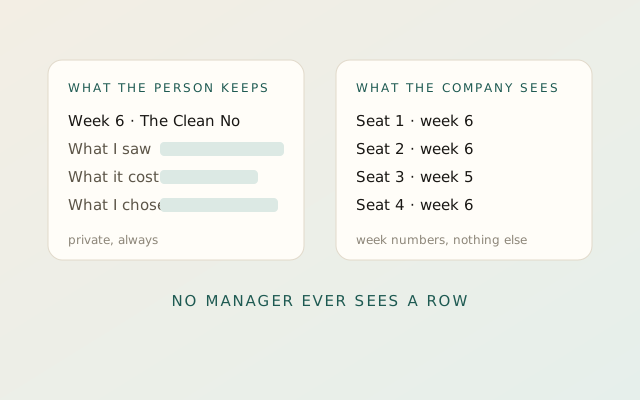
Every seat gets Part One. The company sees week numbers, nothing else.
Which week each seat is on. Whether it is active. The invoice.
Any log. Any answer. Any pattern name. Who said "not today".
Per seat, one payment, invoice. The founder takes the first ten calls.
I said we could work something out before I had decided anything, and then I paid for it in weekends.
I say what I can do at that number, and I let the no be theirs.
- Relationships
- Health
- Wealth
- Happiness
- Career
How it works
Ten minutes a day. Nothing to track.
- 1
Day 1 · In your browser
One short story, three questions. Ten minutes, no account.
- 2
Days 2 to 6 · On WhatsApp
One message a day. Reply in a word, or "not today".
- 3
Day 7 · Your log seals
What you saw, what it cost, what you chose.
You might recognise this
Marek shoots weddings, and his rate is whatever the person in front of him seems willing to pay.Read the story
Marek shoots weddings, and his rate is whatever the person in front of him seems willing to pay. When a bride winces at it over coffee, he hears himself say "I'm sure we can work something out" before he has decided anything. The sentence leaves on its own. By August he is editing until 2 a.m. with a shoulder that clicks on every mouse stroke.
His accountant, Ilse, lays it out on one page. The three cheap jobs filled the exact dates on which two good enquiries arrived, and he declined those for being full. Not I lost money, she says. I bought exhaustion with the money I did not charge. On the next call, when the wince comes, he catches the old sentence in his throat and says instead: "What I can do at that number is four hours instead of ten." She takes the four hours. Nothing breaks.
From The Clean No.
The turn
Client work goes home with people through one specific door: the warm yes that nobody could deliver. It was meant to protect the relationship and it spends it instead, monthly, because the person on the other end stopped looking for alternatives the moment they heard it.
Keep reading
A no on Monday is an inconvenience; the same no on Friday is a wrecked weekend for somebody who was counting on you. Said in the first conversation, a counteroffer is almost never received as a rejection. It is received as information.
What a client-facing team gets from Keel is that catch made on the Tuesday it happens, not in the post-mortem.
Why it is called Keel
The part of the boat you never see.
A keel sits under the waterline. Nobody admires it from the dock. But when the wind hits, it is the reason a boat stays upright and holds its course instead of going wherever it is pushed.
What it costs
Free for the person. Per seat for the company.
- Ten minutes in your browser
- Six days on WhatsApp
- Your first log, sealed
- Eleven weeks for every seat
- No manager ever sees a log
- Price set with the first ten teams
Parts Two to Four are $199 each, and each one opens when you finish the part before.
What you can count on
Four promises, kept by how it is built.
Private by design
The company sees which week each seat is on. Never a log, an answer or a name.
Nothing renews
Part One is one payment. No subscription, no auto-renew, no countdown.
Honest about what it is not
Not therapy. If what comes up is more than a pattern, Keel points you to real help.
Built on published work
94 sources, from Heidegger to Frankl. The whole bibliography is public.
One question a day, and your own words back. No feed, no streak, no leaderboard. I answer every message and take the first ten team calls myself. If session one shows you nothing true in ten minutes, close the tab; it kept nothing.
Krish, founder
How do you handle a client who keeps expanding the scope?
Name it while it is still small and still a favour. Scope creep is not a series of unreasonable demands; it is a series of requests that were answered warmly and never priced. The move is the counteroffer said early: this is what we can do inside the current agreement, and here is what the rest would cost in time or money. Said in the same week, it reads as competence rather than conflict.
What do you do when a client is genuinely rude?
Separate your side from theirs. Your side is what you say, when you say it, and how honestly, and it is entirely yours. Their tone, their readiness and their answer were never yours. A clean, specific request delivered well is a complete act whether or not it lands, and grading it by their reaction teaches exactly the wrong lesson. If an account requires people to be diminished to keep it, leaving is a legitimate outcome.
How do people stop taking a bad account home?
Usually by finding the sentence they never said. What follows an account into the evening is almost never the client's behaviour; it is the thing that has gone unsaid, replayed and sharpened at eleven at night. Written down and delivered plainly in working hours, it stops running. That is a habit a team can practise in a week, not a personality anybody has to acquire.
What can the company see about its people?
Which week each seat is on, whether the seat is active, and the invoice. That is the whole of it. You never see a log, an answer, a name for anybody's pattern, or who said "not today". No manager ever sees a log. It is built that way rather than configured that way, and it is the reason somebody will write down what a client account is actually costing them.
How is it bought for a team?
Per seat, one payment, no subscription, on an invoice rather than a card. Pricing is being set with the first ten teams instead of announced here, so there is no figure on this page. The founder takes those ten calls himself, twenty minutes and no deck. If you run the agency, run session one yourself before anyone else is asked to.
Read next
Ten minutes, no account, and you'll have your own version of this named.
Run session one yourself first. Then talk to the founder about seats.