De-escalation training that starts before the customer shouts
By the time the voice rises, the upset has been running for days.
Ten minutes, no account. Feel it before anyone signs anything.
- No manager ever sees a log
- 94 published sources
- Per seat, one payment, invoice
The short answer
De-escalation is usually taught as a set of moves for the loud part of a call: lower your voice, use their name, never say calm down. Those help, and they arrive late. Every upset is running on one of three things, and it was running long before the volume changed: something the person wanted got blocked, something they expected did not happen, or something they needed to say never got said. The third produces most of the shouting, because someone who has not been heard reaches for the only instrument left.
Named out loud, the upset shrinks to a workable size. Tomorrow, on the first heated contact, ask one question before anything else: what did you expect would happen? Then say their answer back in their own words, without improving it.
How it runs for a team
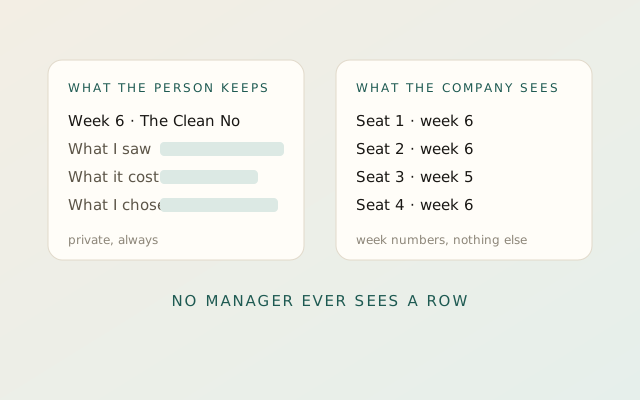
Every seat gets Part One. The company sees week numbers, nothing else.
Which week each seat is on. Whether it is active. The invoice.
Any log. Any answer. Any pattern name. Who said "not today".
Per seat, one payment, invoice. The founder takes the first ten calls.
He was not shouting about the refund. He had said the same thing twice and nobody had ever repeated it back.
I name what is running before I answer the words.
- Relationships
- Health
- Wealth
- Happiness
- Career
How it works
Ten minutes a day. Nothing to track.
- 1
Day 1 · In your browser
One short story, three questions. Ten minutes, no account.
- 2
Days 2 to 6 · On WhatsApp
One message a day. Reply in a word, or "not today".
- 3
Day 7 · Your log seals
What you saw, what it cost, what you chose.
You might recognise this
Ivan spends a weekend building the deck for Monday's pitch.Read the story
Ivan spends a weekend building the deck for Monday's pitch. In the meeting his manager presents it, page after page of Ivan's weekend, and thanks the team at the end. Ivan smiles. Says nothing. Then he sits through two more agenda items hearing none of them, and that night drafts a resignation letter he never sends. He tells his girlfriend his manager is a credit thief, which feels true, and being agreed with does not touch the ache at all.
So on Wednesday he sits with it properly, out on the balcony. When he presses on the bruise, the live part is not about credit. He had wanted the room to look up and see someone ready for the next level. Every slide had been a quiet sentence saying look what I can carry, and his bid had vanished unanswered, because nobody in that room knew he had made one.
From The Upset Decoder.
The turn
An undiagnosed upset runs the person having it, and it runs the person receiving it too. An agent who cannot name what is under a call takes it personally, carries it into the next one, and by Thursday is tired in a way that sleep does not fix.
Keep reading
Named, the same call is a specific, workable size: an expectation nobody agreed to, or a sentence that has not been said yet.
What a support team gets from Keel is ten minutes a day and a line at the end of the week, in their own words, about what the shouting was actually made of.
Why it is called Keel
The part of the boat you never see.
A keel sits under the waterline. Nobody admires it from the dock. But when the wind hits, it is the reason a boat stays upright and holds its course instead of going wherever it is pushed.
What it costs
Free for the person. Per seat for the company.
- Ten minutes in your browser
- Six days on WhatsApp
- Your first log, sealed
- Eleven weeks for every seat
- No manager ever sees a log
- Price set with the first ten teams
Parts Two to Four are $199 each, and each one opens when you finish the part before.
What you can count on
Four promises, kept by how it is built.
Private by design
The company sees which week each seat is on. Never a log, an answer or a name.
Nothing renews
Part One is one payment. No subscription, no auto-renew, no countdown.
Honest about what it is not
Not therapy. If what comes up is more than a pattern, Keel points you to real help.
Built on published work
94 sources, from Heidegger to Frankl. The whole bibliography is public.
One question a day, and your own words back. No feed, no streak, no leaderboard. I answer every message and take the first ten team calls myself. If session one shows you nothing true in ten minutes, close the tab; it kept nothing.
Krish, founder
What is de-escalation training?
Usually a short course in tone, pacing and phrasing for the moment a contact turns hot: slow down, acknowledge, avoid the words that add heat, know when to hand over. It is worth having and it is a late intervention. The part that decides how a call goes is earlier, in whether the agent can tell what the person is actually upset about before answering the sentence they said.
Why does "please calm down" make it worse?
Because it answers the volume rather than the thing under it, and it tells the person their reaction is the problem. Someone raising their voice has usually already tried the quiet version, twice. What lowers the temperature is evidence that the content arrived: their expectation said back in their words, before any policy, apology or fix is offered.
How do agents stop taking angry customers home?
By being able to name what the call was made of. What follows an agent home is not the shouting; it is the meaning they added to it in the four seconds afterwards, replayed all evening. Separating what the customer actually said from what got supplied is a ten-minute skill, and it is the difference between a hard hour and a ruined week.
What can the company see about its people?
Which week each seat is on, whether the seat is active, and the invoice. That is the entire list. You never see a log, an answer, a name for anybody's pattern, or who said "not today". No manager ever sees a log. It is built that way rather than switched on that way, which is why an agent will write down the call that actually got to them instead of the one that reads well.
How is it bought for a team?
Per seat, one payment, no subscription, on an invoice rather than a card. Pricing is being set with the first ten teams rather than published here, so there is no figure on this page. The founder takes those ten calls himself, twenty minutes and no deck. If you run support, run session one yourself first: it takes ten minutes and answers most of the questions a deck would.
Read next
Ten minutes, no account, and you'll have your own version of this named.
Run session one yourself first. Then talk to the founder about seats.