Coaching for a whole team, not six executives
The budget reaches six people. The cost sits with the other ninety.
Ten minutes, no account. Feel it before anyone signs anything.
- No manager ever sees a log
- 94 published sources
- Per seat, one payment, invoice
The short answer
Employee coaching usually means a coach on retainer for six senior people and a wellness portal for everyone else. The six get an hour a fortnight with someone who knows their name. The rest get a login they use once. The gap is not a fairness problem. It is where the money goes. The expensive weeks are not the six calendars at the top. They are the conversation a team lead postponed for a month, the objection a rep took personally, the commitment that quietly slipped and got padded for by everyone downstream.
What reaches a whole team has to be small enough to survive a Tuesday: ten minutes, on a channel people already have open, one idea a week rather than a day in a room. Tonight, list the three conversations postponed inside your team. That list is the program, and its cost is already being paid.
How it runs for a team
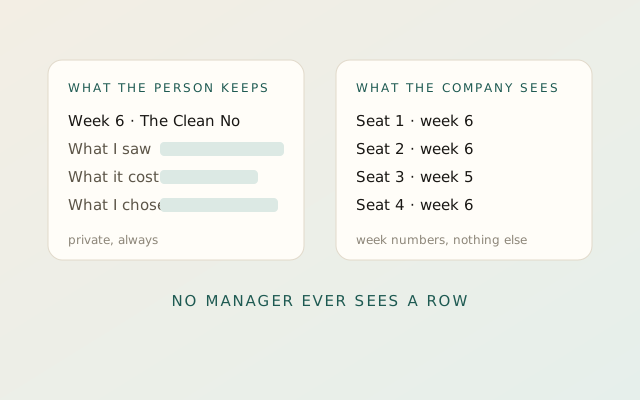
Every seat gets Part One. The company sees week numbers, nothing else.
Which week each seat is on. Whether it is active. The invoice.
Any log. Any answer. Any pattern name. Who said "not today".
Per seat, one payment, invoice. The founder takes the first ten calls.
I decided what the silence in the room meant, then presented to my own story instead of to the person.
I check what the camera saw before I decide what it meant.
- Relationships
- Health
- Wealth
- Happiness
- Career
How it works
Ten minutes a day. Nothing to track.
- 1
Day 1 · In your browser
One short story, three questions. Ten minutes, no account.
- 2
Days 2 to 6 · On WhatsApp
One message a day. Reply in a word, or "not today".
- 3
Day 7 · Your log seals
What you saw, what it cost, what you chose.
You might recognise this
Daniel presents the quarterly roadmap on a Tuesday.Read the story
Daniel presents the quarterly roadmap on a Tuesday. Slide nine is the one he is proudest of, a migration plan nobody else has noticed. Six minutes in, it is going well. Then his director, Renata, picks up her phone, types something, and does not look up for a full minute. Daniel's voice keeps going but his mind has left the room. She is texting the VP that he is not ready. He rushes the last four slides, and when he reaches slide nine he says "I'll skip this in the interest of time," and skips it.
Afterwards Renata catches him at the door. "Sorry I grabbed my phone. My kid's school called. Can you walk me through the piece you skipped? That was the part I wanted." She looked at a phone. Everything else, Daniel supplied himself, and then presented to it instead of to her.
From The Facts and the Story.
The turn
You do not lose weeks to events. You lose them to what somebody decided the event meant.
Keep reading
The meeting held four seconds of actual data, the rest of the afternoon went to the story about it, and the work that got cut was the work the director actually wanted.
Multiply that by a team and it stops being a private matter. It is the roadmap that was not presented, the objection that was not answered, the person who went quiet in October and resigned in March. What a team gets from Keel is that seam made visible while it is still Tuesday, in each person's own words and nobody else's.
Why it is called Keel
The part of the boat you never see.
A keel sits under the waterline. Nobody admires it from the dock. But when the wind hits, it is the reason a boat stays upright and holds its course instead of going wherever it is pushed.
What it costs
Free for the person. Per seat for the company.
- Ten minutes in your browser
- Six days on WhatsApp
- Your first log, sealed
- Eleven weeks for every seat
- No manager ever sees a log
- Price set with the first ten teams
Parts Two to Four are $199 each, and each one opens when you finish the part before.
What you can count on
Four promises, kept by how it is built.
Private by design
The company sees which week each seat is on. Never a log, an answer or a name.
Nothing renews
Part One is one payment. No subscription, no auto-renew, no countdown.
Honest about what it is not
Not therapy. If what comes up is more than a pattern, Keel points you to real help.
Built on published work
94 sources, from Heidegger to Frankl. The whole bibliography is public.
One question a day, and your own words back. No feed, no streak, no leaderboard. I answer every message and take the first ten team calls myself. If session one shows you nothing true in ten minutes, close the tab; it kept nothing.
Krish, founder
What is employee coaching, and can it work for a whole team?
Coaching works when a person gets an accurate look at their own behaviour while it is still running. That does not require a coach on retainer. It requires a small, repeated occasion to look, and something written down afterwards that they can still read in March. The reason it usually reaches only senior people is cost per hour, not effect. Anything that reaches everyone has to be short, regular, and delivered where people already are.
Why does nobody open the wellness program we already pay for?
Because it asks for a visit. A portal of articles, webinars and a benefits directory needs an employee to decide, on a bad Tuesday, to go somewhere and browse. Almost nobody does. What gets used arrives instead: one message, one question, an answer that takes ten minutes, on a channel that is already open. Usage is mostly a delivery problem rather than a motivation problem.
What can the company see about its people?
Which week each seat is on, whether the seat is active, and the invoice. That is the entire list. You never see a log, an answer, a name for anybody's pattern, or who said "not today". No manager ever sees a log. That is not a privacy setting somebody can switch; it is how the product is built, and it is the reason people write the true thing on day one instead of the presentable one.
How is it bought for a team?
Per seat, one payment, no subscription, on an invoice rather than a card. Pricing is being set with the first ten teams rather than announced on a page, so there is no figure here. The founder takes those first ten calls himself, twenty minutes and no deck. If you are thinking about it, run session one yourself first. The buyer should feel the thing before anyone else is asked to.
What does a manager have to run?
Nothing. Each seat gets one ten-minute session a day, delivered on WhatsApp, with no rollout, no kickoff and no internal champion. There are no sessions to schedule and no completion reports to chase, because there is nothing for a manager to chase. If a manager wants to be useful, the move is to do the same week at the same time and say so out loud.
Read next
Ten minutes, no account, and you'll have your own version of this named.
Run session one yourself first. Then talk to the founder about seats.