Leadership training for managers who postpone the conversation
The conversation takes twenty minutes. Postponing it has been a daily job.
Ten minutes, no account. Feel it before anyone signs anything.
- No manager ever sees a log
- 94 published sources
- Per seat, one payment, invoice
The short answer
Leadership training for managers usually fails at one point: the conversation that should have happened in week one and is still unscheduled in week nine. The delay is not weakness. It is arithmetic running the wrong way. The talk costs twenty minutes. Postponing it costs a small daily overhead that nobody bills for: the rereading of their messages, the openings drafted and rejected, the bracing when their name appears.
Two things move it. Open with the thing itself in the first minute: one incident, no preamble, no compliment wrapped around it. Then stop talking and let their answer land before you answer it. That is harder and matters more: a manager who replies before the sentence has finished teaches a team to stop bringing things early. Tonight, name the conversation you have been carrying longest and send a message asking for a time. Not the conversation. Just the time.
How it runs for a team
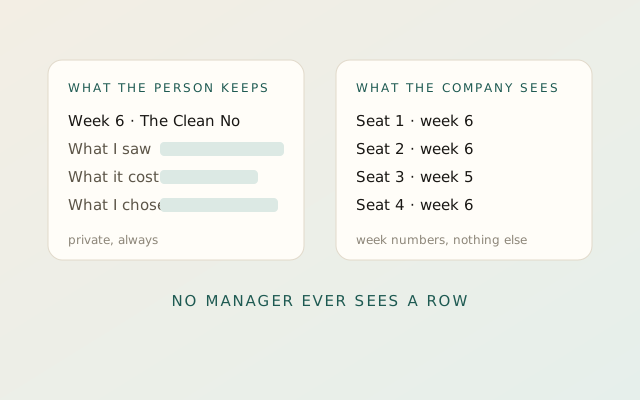
Every seat gets Part One. The company sees week numbers, nothing else.
Which week each seat is on. Whether it is active. The invoice.
Any log. Any answer. Any pattern name. Who said "not today".
Per seat, one payment, invoice. The founder takes the first ten calls.
Nobody brings me a problem early, and I had been calling that peace.
I let it land before I answer it, and the decision comes last.
- Relationships
- Health
- Wealth
- Happiness
- Career
How it works
Ten minutes a day. Nothing to track.
- 1
Day 1 · In your browser
One short story, three questions. Ten minutes, no account.
- 2
Days 2 to 6 · On WhatsApp
One message a day. Reply in a word, or "not today".
- 3
Day 7 · Your log seals
What you saw, what it cost, what you chose.
You might recognise this
Caspian's review is going fine until Hana reaches the last item.Read the story
Caspian's review is going fine until Hana reaches the last item. "People don't bring you problems early," she says, "because you go straight to what they did wrong." His mouth is already moving. He names the outage in March, the night he stayed till two for a junior's mistake, the mentoring hours, the code reviews. Hana listens, and he watches her face close, politely, the way a shop pulls the shutter halfway down. She says, "Fair enough," and moves on to compensation.
Two days later there is a deploy that has been broken since the previous afternoon. Quentin, seven months in, sat on it overnight rather than raise it. Walking over, the sentence forming is "why didn't you just tell someone," and halfway across the floor Caspian hears Hana's sentence instead, arriving late, like a message that finally gets through.
From Taking It In.
The turn
Everything you most need to know about how you land on your team is held by your team, and the only route it has to you is somebody saying it out loud. What keeps it out is rarely rudeness.
Keep reading
It is the context, offered fast, and true. After two or three of those, people stop.
You do not hear the stopping. You hear peace, and you run a quiet team for a year and find out what was in it during an exit interview. What a manager gets from Keel is the gap between the sentence and their answer to it, held open long enough to notice what fired.
Why it is called Keel
The part of the boat you never see.
A keel sits under the waterline. Nobody admires it from the dock. But when the wind hits, it is the reason a boat stays upright and holds its course instead of going wherever it is pushed.
What it costs
Free for the person. Per seat for the company.
- Ten minutes in your browser
- Six days on WhatsApp
- Your first log, sealed
- Eleven weeks for every seat
- No manager ever sees a log
- Price set with the first ten teams
Parts Two to Four are $199 each, and each one opens when you finish the part before.
What you can count on
Four promises, kept by how it is built.
Private by design
The company sees which week each seat is on. Never a log, an answer or a name.
Nothing renews
Part One is one payment. No subscription, no auto-renew, no countdown.
Honest about what it is not
Not therapy. If what comes up is more than a pattern, Keel points you to real help.
Built on published work
94 sources, from Heidegger to Frankl. The whole bibliography is public.
One question a day, and your own words back. No feed, no streak, no leaderboard. I answer every message and take the first ten team calls myself. If session one shows you nothing true in ten minutes, close the tab; it kept nothing.
Krish, founder
How do I give feedback without the person getting defensive?
Expect the defence and do not argue with it. It fires before the content has landed, so answering it puts you both in a debate about who is fair rather than about what happened. Say the sentence once, in the same plain words, then stay quiet. Keep it to one incident: a single item arriving with two years of other items attached is heard as a case, not a request.
It has been months. Is it too late to raise it?
Almost never, and lateness is not the objection it feels like. Age changes the opening rather than the possibility. Name the delay first, plainly, with no story about how busy you were, then say the thing. The other person has usually been carrying their half of it the whole time, and the relief on both sides is generally out of proportion to how hard the sentence was to say.
Why does nobody on my team bring me problems early?
Usually because the first two attempts cost them something small: a fast correction, a context lecture, a "yes, but" that arrived before they finished. Nobody makes a scene about it. They simply route around you next time, and the quiet that follows reads from your chair as a well-run team. The evidence shows up late, as a deploy that sat overnight or a resignation that seemed sudden.
What will I see about the people on my team?
Which week each seat is on, whether the seat is active, and the invoice. Nothing else reaches you. No manager ever sees a log, an answer, a name for a pattern, or who said "not today". It is not a permission you have been denied; it is how the product is built, and it is the only reason the writing on the other side is worth anything.
How is it bought for a team?
Per seat, one payment, no subscription, invoiced rather than put on a card. The price is being set with the first ten teams instead of published, so there is no figure here. The founder takes those first ten calls himself, twenty minutes each. Run session one yourself before you ask anyone else to: a manager who has done the week can say what it is in one sentence.
Read next
Ten minutes, no account, and you'll have your own version of this named.
Run session one yourself first. Then talk to the founder about seats.