A leadership development program that starts with one conversation
Leadership is not taught in a room. It is taught in the next one-on-one.
Ten minutes, no account. Feel it before anyone signs anything.
- No manager ever sees a log
- 94 published sources
- Per seat, one payment, invoice
The short answer
A leadership development program earns its money in the conversations that happen the week after it, not in the room. Most are built the other way round: a cohort, two days offsite, a model with four quadrants, then a calendar where nothing has changed. What people carry back is vocabulary. What they needed was an accurate look at how they land on the people they lead, which arrives only from those people, and only if they think it is safe to say.
So the useful unit is not a module on influence. It is one leader hearing one true sentence about themselves and not answering it in the same breath. Tonight, pick the person on your team most likely to tell you something you would rather not hear, and ask for one thing you do that makes their job harder. Then say nothing for ten seconds after they answer.
How it runs for a team
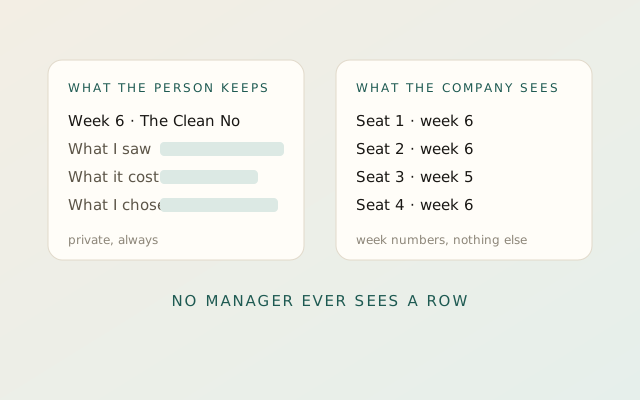
Every seat gets Part One. The company sees week numbers, nothing else.
Which week each seat is on. Whether it is active. The invoice.
Any log. Any answer. Any pattern name. Who said "not today".
Per seat, one payment, invoice. The founder takes the first ten calls.
When my manager says he wants to talk about my scope, I hear a demotion before he reaches the verb.
I let people finish before I decide what they meant.
- Relationships
- Health
- Wealth
- Happiness
- Career
How it works
Ten minutes a day. Nothing to track.
- 1
Day 1 · In your browser
One short story, three questions. Ten minutes, no account.
- 2
Days 2 to 6 · On WhatsApp
One message a day. Reply in a word, or "not today".
- 3
Day 7 · Your log seals
What you saw, what it cost, what you chose.
You might recognise this
Priya's read on her manager, Dale, was set two years ago, when he gave her project a lukewarm review, and it has not been updated since: he does not rate me.Read the story
Priya's read on her manager, Dale, was set two years ago, when he gave her project a lukewarm review, and it has not been updated since: he does not rate me. His "good work" reads as politeness, his silences as confirmation. So in Thursday's one-on-one, when Dale says, "I want to talk about your scope," Priya hears the opening move of a demotion. She talks fast, lists wins, cites the Q3 numbers, defends territory Dale has not attacked.
Dale watches this with visible confusion, then says, "Priya. I'm trying to give you the platform team. It's a step up. I've been trying to hand you bigger things for months, but every time I open the door you fight me at the threshold." Walking out with the promotion, she replays months of one-on-ones with new subtitles.
From Your Listening Filter.
The turn
A leader is a condition in the room. The same person is more honest in front of some listeners than others, and they are not choosing it deliberately; they are reading what can safely be said in front of you.
Keep reading
So the careful, thin version of what your team tells you is partly your own work, and so is everything they have never got round to telling you at all.
That is the thing a program has to move, and it moves one conversation at a time rather than one offsite at a time. What a team gets from Keel is a week per idea, each person watching their own listening while it runs.
Why it is called Keel
The part of the boat you never see.
A keel sits under the waterline. Nobody admires it from the dock. But when the wind hits, it is the reason a boat stays upright and holds its course instead of going wherever it is pushed.
What it costs
Free for the person. Per seat for the company.
- Ten minutes in your browser
- Six days on WhatsApp
- Your first log, sealed
- Eleven weeks for every seat
- No manager ever sees a log
- Price set with the first ten teams
Parts Two to Four are $199 each, and each one opens when you finish the part before.
What you can count on
Four promises, kept by how it is built.
Private by design
The company sees which week each seat is on. Never a log, an answer or a name.
Nothing renews
Part One is one payment. No subscription, no auto-renew, no countdown.
Honest about what it is not
Not therapy. If what comes up is more than a pattern, Keel points you to real help.
Built on published work
94 sources, from Heidegger to Frankl. The whole bibliography is public.
One question a day, and your own words back. No feed, no streak, no leaderboard. I answer every message and take the first ten team calls myself. If session one shows you nothing true in ten minutes, close the tab; it kept nothing.
Krish, founder
What should a leadership development program actually cover?
Less than most cover, and in smaller pieces. The load-bearing parts are narrow: hearing what someone is actually saying before answering it, keeping your word or renegotiating it early, saying a clean no, and noticing what defending a position costs the room. Frameworks are cheap to teach and rarely survive contact with a hard Tuesday. The habits above are the ones people are still using a year later.
How long before anything changes?
Days for the leader, weeks for the people around them. The first shift is private: catching yourself composing a reply while somebody is still speaking. The visible one comes later, when the team starts telling you things earlier and prefacing them less. That change is legible from the outside and it is the fairest test of whether a program did anything at all.
Does it replace the training we already run?
It does not compete with compliance training, systems training or anything role-specific. It sits under them. A manager who can take a piece of feedback without answering it, and say a clean no on Monday rather than a soft yes that fails on Friday, gets more out of every other program you buy, because the material stops bouncing off a position they were defending.
What can the company see about the people on it?
Which week each seat is on, whether the seat is active, and the invoice. That is all of it. No log, no answer, no name for a pattern, no record of who said "not today". No manager ever sees a log, and no HR partner does either. That is built in rather than configured, and it is the reason the writing is honest enough to be worth doing.
How is it bought for a team?
Per seat, one payment, no subscription, on an invoice. The price is being set with the first ten teams rather than announced on a page, so there is no figure here to quote to a finance partner yet. The founder takes those ten calls himself. Before you book one, run session one yourself, because the argument for it is much easier to make once you have felt a week of it.
Read next
Ten minutes, no account, and you'll have your own version of this named.
Run session one yourself first. Then talk to the founder about seats.