New manager training for the first hard week
The promotion is the easy part. The first no is not.
Ten minutes, no account. Feel it before anyone signs anything.
- No manager ever sees a log
- 94 published sources
- Per seat, one payment, invoice
The short answer
New manager training usually arrives as systems: one-on-one templates, a review cycle, a delegation model. None of it covers the first hard week, which is normally a request you have to decline, a piece of pushback you have to take without flinching, and somebody who used to be a peer watching which of the two you do badly.
Three moves carry most of it. A request has four honest answers, not one: yes, no, "not that, but this", and "I will tell you by Thursday". Say the true one early, because a no on Monday is an inconvenience and the same no on Friday wrecks somebody's weekend. When a person disagrees with you, notice whether you are listening or waiting. And say a correction while it is still small. Tonight, write down the request you gave a soft yes to and do not intend to deliver, and send the counteroffer.
How it runs for a team
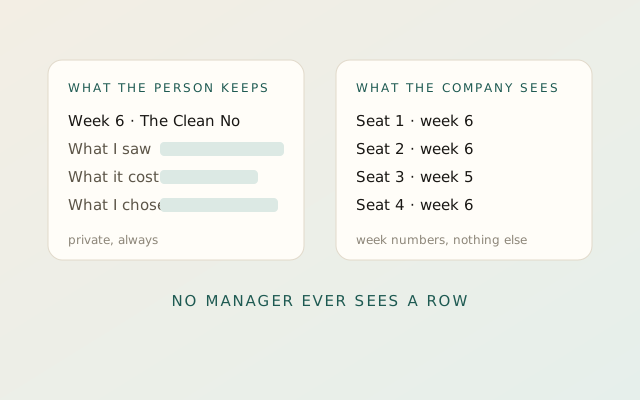
Every seat gets Part One. The company sees week numbers, nothing else.
Which week each seat is on. Whether it is active. The invoice.
Any log. Any answer. Any pattern name. Who said "not today".
Per seat, one payment, invoice. The founder takes the first ten calls.
I win the point and the room gets colder.
I'm someone people can disagree with.
- Relationships
- Health
- Wealth
- Happiness
- Career
How it works
Ten minutes a day. Nothing to track.
- 1
Day 1 · In your browser
One short story, three questions. Ten minutes, no account.
- 2
Days 2 to 6 · On WhatsApp
One message a day. Reply in a word, or "not today".
- 3
Day 7 · Your log seals
What you saw, what it cost, what you chose.
You might recognise this
Mateo runs the kitchen, and he has been right about the menu for three seasons.Read the story
Mateo runs the kitchen, and he has been right about the menu for three seasons. Genuinely right: the margins, the covers, the reviews all say so. In the lull before the second seating, his sous-chef Simone starts to flag a problem with the new dish, something about the timing on the fish, and before she finishes her second sentence he is already saying, half-turned back to the pass, "we've been through this." He is not angry. He barely raises his voice. But everyone, at once, finds something to stir.
A week later the newest cook tells him that people have started checking things with each other before Mateo arrives, "so it doesn't turn into a whole thing." Mateo stands in the walk-in with the door shut. The menu might be correct. He is no longer the person people think with. He is the person people cook around.
From The Cost of Being Right.
The turn
A new manager is read constantly and told almost nothing. In the first weeks a team is working out what is safe to raise with you, and they settle it on small evidence: how you take the first piece of pushback, whether your yes means anything, how long it takes you to say a no.
Keep reading
None of that is in the handbook, and most of it is decided by about week six.
What a new manager gets from Keel is one of those moves a week, caught in their own words while it is still small enough to change, and kept where nobody senior to them can read it.
Why it is called Keel
The part of the boat you never see.
A keel sits under the waterline. Nobody admires it from the dock. But when the wind hits, it is the reason a boat stays upright and holds its course instead of going wherever it is pushed.
What it costs
Free for the person. Per seat for the company.
- Ten minutes in your browser
- Six days on WhatsApp
- Your first log, sealed
- Eleven weeks for every seat
- No manager ever sees a log
- Price set with the first ten teams
Parts Two to Four are $199 each, and each one opens when you finish the part before.
What you can count on
Four promises, kept by how it is built.
Private by design
The company sees which week each seat is on. Never a log, an answer or a name.
Nothing renews
Part One is one payment. No subscription, no auto-renew, no countdown.
Honest about what it is not
Not therapy. If what comes up is more than a pattern, Keel points you to real help.
Built on published work
94 sources, from Heidegger to Frankl. The whole bibliography is public.
One question a day, and your own words back. No feed, no streak, no leaderboard. I answer every message and take the first ten team calls myself. If session one shows you nothing true in ten minutes, close the tab; it kept nothing.
Krish, founder
What should a first-time manager learn first?
How to decline something cleanly. Almost every early failure traces to a soft yes: the deadline agreed to in a standup because the room was quiet, the favour accepted for a peer, the scope taken on to seem willing. A no in the first conversation is an inconvenience. The same no three weeks later has already cost somebody a plan they built on it.
How do I manage people who used to be my peers?
Say the awkward thing out loud once, early, rather than performing a new version of yourself. Most of the difficulty comes from the pretending: a lower voice, a borrowed style, scripts run in one-on-ones. People can tell, and it costs more trust than the promotion did. Name the change plainly, keep your word visibly for a month, and let the rest settle.
How do I stop shutting down disagreement without noticing?
Watch for the small physical version. The half-turn away, the "we have been through this", the answer that starts before the other person's second sentence. None of it feels like shutting anyone down from the inside; it feels like efficiency. The tell is in the room rather than in you: people check things with each other before they check them with you.
What can the company see about a manager who is on it?
Which week the seat is on, whether it is active, and the invoice. Nothing about what was written. No log, no answer, no name for a pattern, no record of who said "not today". No manager ever sees a log, and nobody above them sees one either. That is built into the product rather than granted by a setting, and it is why a new manager can be honest in it.
How is it bought for a group of new managers?
Per seat, one payment, no subscription, on an invoice. The price is being set with the first ten teams rather than posted here, so there is no figure on the page. The founder takes those ten calls himself and they run about twenty minutes. Do session one first, in your own words, before deciding whether the people you promoted should have it.
Read next
Ten minutes, no account, and you'll have your own version of this named.
Run session one yourself first. Then talk to the founder about seats.