Sales coaching that survives the week after the workshop
The room is not the problem. The Thursday after the room is.
Ten minutes, no account. Feel it before anyone signs anything.
- No manager ever sees a log
- 94 published sources
- Per seat, one payment, invoice
The short answer
Sales coaching fails in a predictable place. The workshop is good, the role play is honest, everyone leaves with a page of intentions, and by the following Thursday the pipeline notes read exactly like last month's. Nothing was rejected. The commitments simply expired, one reasonable rescheduling at a time, and the shortfall got explained afterwards by the market.
What survives a week is not more content. It is a smaller promise with a date somebody has checked, and the habit of saying early when that date is going to move. Coaching that reaches the week between the calls is worth more than coaching that is excellent for a day. Tonight, take one stalled deal and find the thing you said you would do and have not done. That is the drag, and it is not the market.
How it runs for a team
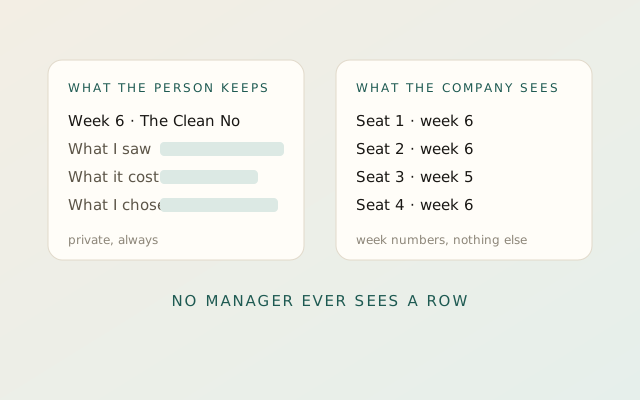
Every seat gets Part One. The company sees week numbers, nothing else.
Which week each seat is on. Whether it is active. The invoice.
Any log. Any answer. Any pattern name. Who said "not today".
Per seat, one payment, invoice. The founder takes the first ten calls.
The deal did not stall on price. It stalled on a follow-up I said I would send eleven days ago.
I only give dates I have checked, and I say early when one is going to move.
- Relationships
- Health
- Wealth
- Happiness
- Career
How it works
Ten minutes a day. Nothing to track.
- 1
Day 1 · In your browser
One short story, three questions. Ten minutes, no account.
- 2
Days 2 to 6 · On WhatsApp
One message a day. Reply in a word, or "not today".
- 3
Day 7 · Your log seals
What you saw, what it cost, what you chose.
You might recognise this
Kofi and his oldest friend, Tunde, run a weekend photography business.Read the story
Kofi and his oldest friend, Tunde, run a weekend photography business. Tunde shoots, Kofi handles the paperwork. A year ago Kofi said he would get their liability insurance sorted this month. He meant it. The form sat in a browser tab, then in a folder, then in the place where things stop being seen.
In the spring a wedding venue emailed asking for the certificate. There was no certificate. The venue was polite and gave the date to someone else. Eleven hundred dollars, gone in one email in which nobody raised their voice. Since then the business idles in a way neither of them names, and Kofi tells himself the market is slow, and the market genuinely is slow, which is what makes the explanation so comfortable. Going over the books one night he saw it plainly: the market did not cancel that booking. An unhandled form did.
From The Workability Effect.
The turn
A broken agreement is not a verdict on anybody's character, which is exactly why treating it as one keeps it hidden. Treated as structure it is a bent spoke: not shameful, not ignorable, because the wheel does not care about the reasons.
Keep reading
Every unkept commitment leaks hours into managing, avoiding and explaining, and the number underneath it quietly comes in lower while the explanation points at the market.
What a sales team gets from Keel is the smallest useful version of coaching: one idea a week, ten minutes a day, and a written line at the end of the week naming one agreement and what it cost.
Why it is called Keel
The part of the boat you never see.
A keel sits under the waterline. Nobody admires it from the dock. But when the wind hits, it is the reason a boat stays upright and holds its course instead of going wherever it is pushed.
What it costs
Free for the person. Per seat for the company.
- Ten minutes in your browser
- Six days on WhatsApp
- Your first log, sealed
- Eleven weeks for every seat
- No manager ever sees a log
- Price set with the first ten teams
Parts Two to Four are $199 each, and each one opens when you finish the part before.
What you can count on
Four promises, kept by how it is built.
Private by design
The company sees which week each seat is on. Never a log, an answer or a name.
Nothing renews
Part One is one payment. No subscription, no auto-renew, no countdown.
Honest about what it is not
Not therapy. If what comes up is more than a pattern, Keel points you to real help.
Built on published work
94 sources, from Heidegger to Frankl. The whole bibliography is public.
One question a day, and your own words back. No feed, no streak, no leaderboard. I answer every message and take the first ten team calls myself. If session one shows you nothing true in ten minutes, close the tab; it kept nothing.
Krish, founder
Why does sales training stop working a week later?
Because a training day produces announcements, and an announcement is not an agreement until it has a date and a person on it. Back at a real desk the day is full, the intention slides once, reasonably, and nobody is ever heard to abandon anything. That is why the follow-up matters more than the content, and why the useful unit is a week rather than a day.
What is worth coaching, if not the pitch?
The pitch is usually the part already covered. What is not covered is the ask made in one sentence without a hook in it, the decline said early instead of on Friday, the counteroffer nobody has ever used, and the follow-up that was promised and not sent. Those four decide more revenue than phrasing does, and none of them are hard to learn.
How much time does a rep have to give this?
Ten minutes a day, delivered where they already are, with one idea a week rather than a day in a room. There is no session to schedule, no travel and no internal champion. If a manager wants to be useful the move is to run the same week at the same time and say so out loud, not to chase completion.
What can the company see about its reps?
Which week each seat is on, whether the seat is active, and the invoice. That is the entire list. You never see a log, an answer, a name for anybody's pattern, or who said "not today". No manager ever sees a log. That is how it is built rather than a setting somebody chose, and it is why a rep will write the true thing about a slipped commitment instead of the version that survives a forecast call.
How is it bought for a team?
Per seat, one payment, no subscription, on an invoice rather than a card. Pricing is being set with the first ten teams rather than announced on a page, so there is no figure here. The founder takes those ten calls himself, twenty minutes, no deck. Run session one yourself before you buy for anyone, because the buyer should feel it first.
Read next
Ten minutes, no account, and you'll have your own version of this named.
Run session one yourself first. Then talk to the founder about seats.