Sales training for reps who take the no personally
A no is information. It only costs you a week once it becomes a verdict.
Ten minutes, no account. Feel it before anyone signs anything.
- No manager ever sees a log
- 94 published sources
- Per seat, one payment, invoice
The short answer
Most sales training teaches the call. Very little of it touches the four minutes after a no, which is where the quarter is actually lost. A rep who hears "not now" as data makes the next call. A rep who hears it as a report on whether they are any good spends the afternoon building a private case, then makes the next call carefully, with the hedge already in their voice, and buyers hear a hedge in the first sentence.
This is not a resilience problem. It is the gap between what the buyer said and what the rep decided it meant about them. Tonight, ask one rep to write their last no in two columns: the words the buyer actually used on the left, everything they added on the right. The right column is what is costing you the follow-up.
How it runs for a team
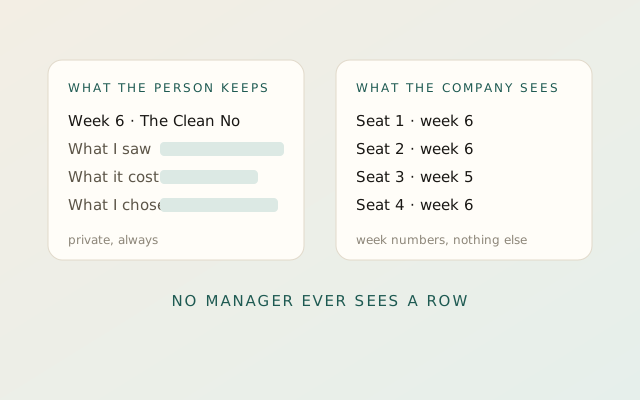
Every seat gets Part One. The company sees week numbers, nothing else.
Which week each seat is on. Whether it is active. The invoice.
Any log. Any answer. Any pattern name. Who said "not today".
Per seat, one payment, invoice. The founder takes the first ten calls.
A no goes into the file as evidence about me, and the next call goes out with the hedge already in my voice.
What a buyer says about the offer is not a report on me.
- Relationships
- Health
- Wealth
- Happiness
- Career
How it works
Ten minutes a day. Nothing to track.
- 1
Day 1 · In your browser
One short story, three questions. Ten minutes, no account.
- 2
Days 2 to 6 · On WhatsApp
One message a day. Reply in a word, or "not today".
- 3
Day 7 · Your log seals
What you saw, what it cost, what you chose.
You might recognise this
Camille has out-earned every milestone she once swore would settle it, so why does every launch feel like a trial she narrowly survived? She gets her answer at the quarterly review, when a VP leans forward and challenges one of her numbers.Read the story
Camille has out-earned every milestone she once swore would settle it, so why does every launch feel like a trial she narrowly survived? She gets her answer at the quarterly review, when a VP leans forward and challenges one of her numbers. Reasonable question, ordinary tone. Camille hears her own voice go sharp before she has chosen anything. She is not defending the analysis. The analysis is fine and she knows it. She is defending herself.
That night she replays it and hears it plainly from the outside: she argued like the number was her character. She tries an experiment for a week. Same meetings, same numbers under fire; she just stops treating outcomes as evidence about her. She asks the dumber questions she had been too senior to risk. She concedes a point in front of everyone and notices, with real surprise, that she does not bleed.
From Playing From Win.
The turn
A rep playing to prove something plays tight. They hedge the ask, defend the objection instead of answering it, avoid the account where they might be seen failing, and win the small ones without enjoying any of it.
Keep reading
Nothing in the pipeline explains that, so nothing in the pipeline review fixes it. Take the trial out and the swing gets bigger: an objection becomes a question, and a no becomes a fact about a buyer's quarter.
What a sales team gets from Keel is that catch made in the week it is running, in each rep's own words, ten minutes at a time.
Why it is called Keel
The part of the boat you never see.
A keel sits under the waterline. Nobody admires it from the dock. But when the wind hits, it is the reason a boat stays upright and holds its course instead of going wherever it is pushed.
What it costs
Free for the person. Per seat for the company.
- Ten minutes in your browser
- Six days on WhatsApp
- Your first log, sealed
- Eleven weeks for every seat
- No manager ever sees a log
- Price set with the first ten teams
Parts Two to Four are $199 each, and each one opens when you finish the part before.
What you can count on
Four promises, kept by how it is built.
Private by design
The company sees which week each seat is on. Never a log, an answer or a name.
Nothing renews
Part One is one payment. No subscription, no auto-renew, no countdown.
Honest about what it is not
Not therapy. If what comes up is more than a pattern, Keel points you to real help.
Built on published work
94 sources, from Heidegger to Frankl. The whole bibliography is public.
One question a day, and your own words back. No feed, no streak, no leaderboard. I answer every message and take the first ten team calls myself. If session one shows you nothing true in ten minutes, close the tab; it kept nothing.
Krish, founder
Why do good reps take rejection personally?
Because the same skill that makes them good makes the no land as a verdict. A rep who cares reads the call closely, and reading closely means supplying meaning fast: the pause meant doubt, the short reply meant they are not serious about me. Almost none of that is in the transcript. It is added in under a second and then acted on for the rest of the afternoon.
Can you train a rep out of it?
You cannot train the reaction away, and trying tends to add shame to it. What can change is the order. The sting lands, and then, before it turns into a case, the rep separates what the buyer actually said from what they added. Reps who practise that separation for a week describe the same thing: the next dial gets made sooner and sounds less careful.
How is this different from a sales training day?
A training day is excellent for a day. This is one idea a week, ten minutes a day, on a channel the team already has open, and it lands on the Tuesdays where the objection actually arrives. There is no room to book, no rollout and no completion report, because there is nothing for a manager to chase.
What can the company see about its reps?
Which week each seat is on, whether the seat is active, and the invoice. That is the whole list. You never see a log, an answer, a name for anybody's pattern, or who said "not today". No manager ever sees a log. That is how it is built, and it is exactly why a rep will write down the true thing about a lost deal instead of the version that would survive a pipeline review.
How is it bought for a team?
Per seat, one payment, no subscription, on an invoice rather than a card. Pricing is being set with the first ten teams rather than published here, so there is no figure on this page. The founder takes those ten calls himself, twenty minutes and no deck. If you lead the team, run session one yourself first and decide from that.
Read next
Ten minutes, no account, and you'll have your own version of this named.
Run session one yourself first. Then talk to the founder about seats.