Decision fatigue
It is not the number of decisions. It is the ones you make twice.
Ten minutes, no account. Feel it before anyone signs anything.
- No manager ever sees a log
- 94 published sources
- Per seat, one payment, invoice
The short answer
Decision fatigue is usually described as a supply problem: a finite number of good decisions in a day, spent on lunch and email before the real one arrives. Cutting the trivial ones back does help, and for anyone running something it is the smaller half. The heavier load is the decisions that never stay decided. The hire reopened every bad month, the pricing settled twice a quarter, the exit file updated after every setback. Each was made by weighing reasons, and reasons are weather. When the evidence moves, the thing is back on your desk and you pay for it again.
Tonight, list the three you have reopened this quarter. Take one and set its reasons down, one at a time, then look at what is still standing. What survives that, you chose. What goes when the reasons go will be back on a bad Tuesday.
How it runs for a team
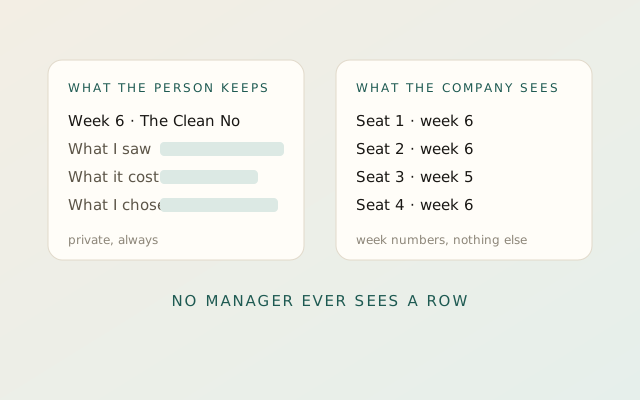
Every seat gets Part One. The company sees week numbers, nothing else.
Which week each seat is on. Whether it is active. The invoice.
Any log. Any answer. Any pattern name. Who said "not today".
Per seat, one payment, invoice. The founder takes the first ten calls.
I make eleven decisions a day and four of them are ones I already made in March.
What I have chosen does not go back on the list.
- Relationships
- Health
- Wealth
- Happiness
- Career
How it works
Ten minutes a day. Nothing to track.
- 1
Day 1 · In your browser
One short story, three questions. Ten minutes, no account.
- 2
Days 2 to 6 · On WhatsApp
One message a day. Reply in a word, or "not today".
- 3
Day 7 · Your log seals
What you saw, what it cost, what you chose.
You might recognise this
Ottilie came to Lisbon for a job that ended two years ago, and she has been explaining why she stays ever since.Read the story
Ottilie came to Lisbon for a job that ended two years ago, and she has been explaining why she stays ever since. The light. The rent, which was true once. The friends, three of whom have left. Her mother asks on every call what is keeping her there, and Ottilie produces the list, and the list works, and the call ends. What she notices, though only much later, is that she runs it on herself too, on the bad days, standing at the tram stop in the rain, checking whether the city still qualifies.
One evening in November she is too tired to run anything. She reaches for the list out of habit and cannot be bothered to assemble it, and in the gap where the reasons should be, something is still standing: she wants to be here.
From Choosing, Not Deciding.
The turn
A leader's worst hours rarely go to new problems. They go to the retrying: the Sunday audit of a company you already own, the same argument with the same co-founder in a slightly different costume.
Keep reading
The court never adjourns, because a verdict has grounds and grounds can be challenged, so the part of you that made the call stays on retainer, re-checking. That is where the tiredness comes from, and no amount of simplifying your lunch touches it.
What a team gets from Keel is ten minutes a day and a written record of which decisions are actually choices, in each person's own words and readable by nobody else.
Why it is called Keel
The part of the boat you never see.
A keel sits under the waterline. Nobody admires it from the dock. But when the wind hits, it is the reason a boat stays upright and holds its course instead of going wherever it is pushed.
What it costs
Free for the person. Per seat for the company.
- Ten minutes in your browser
- Six days on WhatsApp
- Your first log, sealed
- Eleven weeks for every seat
- No manager ever sees a log
- Price set with the first ten teams
Parts Two to Four are $199 each, and each one opens when you finish the part before.
What you can count on
Four promises, kept by how it is built.
Private by design
The company sees which week each seat is on. Never a log, an answer or a name.
Nothing renews
Part One is one payment. No subscription, no auto-renew, no countdown.
Honest about what it is not
Not therapy. If what comes up is more than a pattern, Keel points you to real help.
Built on published work
94 sources, from Heidegger to Frankl. The whole bibliography is public.
One question a day, and your own words back. No feed, no streak, no leaderboard. I answer every message and take the first ten team calls myself. If session one shows you nothing true in ten minutes, close the tab; it kept nothing.
Krish, founder
What is decision fatigue?
The ordinary version is depletion: the quality of your choices drops as the day goes on, so the last call of the afternoon is worse than the first. That is real, and it is why routine and delegation help. The version that costs a leader more is different. It is the same decisions arriving repeatedly, already made once, because nothing about the first pass actually closed them.
Does simplifying small decisions fix it?
Partly, and it is cheap, so do it. Fix the recurring meeting, delete the choice about lunch, give somebody else the vendor call. What it will not touch is the loop underneath: a decision held together by its reasons can be reopened the moment the reasons thin out, and reopening one of those costs more than a hundred small choices did.
Why do the same decisions keep coming back?
Because they were settled on evidence, and anything settled on evidence can be retried the day the evidence changes. Every option you did not take stays filed as a standing objection, so the more carefully you weighed, the more objections you carry. The loop ends when the thing stops being held by its reasons, which is a different act from weighing them again more thoroughly.
What can the company see about its people?
Which week each seat is on, whether the seat is active, and the invoice. Nothing else exists on the buyer's side. You never see a log, an answer, a name for anybody's pattern, or who said "not today". No manager ever sees a log. That is how it is built rather than a preference somebody set, and it is the reason people write the true thing rather than the presentable one.
How is it bought for a team?
Per seat, one payment, no subscription, on an invoice rather than a card. Pricing is being set with the first ten teams instead of announced here, so there is no figure on this page. The founder takes those ten calls himself, twenty minutes, no deck. For yourself there is nothing to buy first: run session one and decide afterwards.
Read next
Ten minutes, no account, and you'll have your own version of this named.
Run session one yourself first. Then talk to the founder about seats.