How much does executive coaching cost
The rate is the easy part. What the hour buys is the question.
Ten minutes, no account. Feel it before anyone signs anything.
- No manager ever sees a log
- 94 published sources
- Per seat, one payment, invoice
The short answer
Executive coaching in the United States typically runs $300 to $700 an hour, above the $100 to $300 a general life coach charges, and higher again for coaches who work with chief executives. Most of it is sold as an engagement rather than an hour: six months, typically $10,000 to $30,000 or more, sometimes several times that at the top of a large company. None of it is licensed, so the fee reports the market and the coach's confidence rather than their training.
Do the arithmetic before you sign. Six months of fortnightly hours is twelve hours of attention spread across about a hundred and twenty working days. Whatever changes happens on the hundred and eight days in between. Tonight, write down the decision you have reopened three times this quarter. If it is still open in a fortnight, the hour was never the missing thing.
How it runs for a team
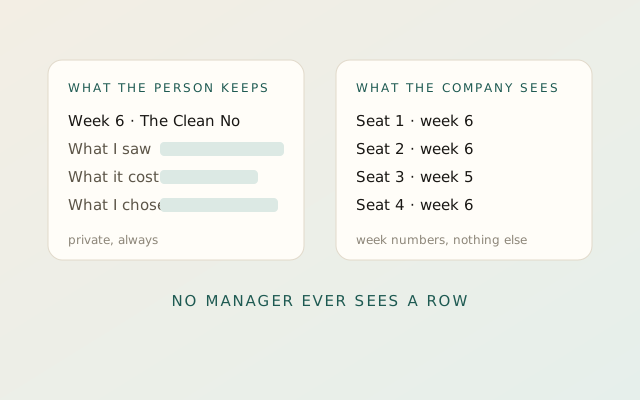
Every seat gets Part One. The company sees week numbers, nothing else.
Which week each seat is on. Whether it is active. The invoice.
Any log. Any answer. Any pattern name. Who said "not today".
Per seat, one payment, invoice. The founder takes the first ten calls.
I paid for an hour with an expert and spent it explaining why the numbers must be wrong.
I stop being opposing counsel in rooms I am paying for.
- Relationships
- Health
- Wealth
- Happiness
- Career
How it works
Ten minutes a day. Nothing to track.
- 1
Day 1 · In your browser
One short story, three questions. Ten minutes, no account.
- 2
Days 2 to 6 · On WhatsApp
One message a day. Reply in a word, or "not today".
- 3
Day 7 · Your log seals
What you saw, what it cost, what you chose.
You might recognise this
Renee has held the same view on money since her twenties, and held it out loud: renting is throwing it away, and property is the only investment that is real.Read the story
Renee has held the same view on money since her twenties, and held it out loud: renting is throwing it away, and property is the only investment that is real. So when she finally hired the fee-only adviser, she was expecting a plan, not an argument. The adviser ran her actual numbers: her city, her deposit, her decade. The spreadsheet said the opposite of the sentence. Politely, in columns, but it said it.
From that moment she stopped being a client and became opposing counsel. Her parents' house, which quadrupled. The 2016 market. A cousin who got lucky in a suburb nobody wanted. It is in the car afterwards that the odd fact surfaces: in a full hour with an expert she was paying for, she never once asked a question about the actual numbers.
From The Cost of Being Right.
The turn
An expensive hour is only worth what you let into it, and the people a company buys those hours for are the ones best at building a case. The rebuttal is assembled before the sentence has finished, and from the inside it does not feel like defending.
Keep reading
It feels like accuracy. That is why the fee so often buys a good conversation and no different Tuesday.
What a team gets from Keel is the six days between the calls: one idea a week, ten minutes a day, and a line at the end of it in each person's own words.
Why it is called Keel
The part of the boat you never see.
A keel sits under the waterline. Nobody admires it from the dock. But when the wind hits, it is the reason a boat stays upright and holds its course instead of going wherever it is pushed.
What it costs
Free for the person. Per seat for the company.
- Ten minutes in your browser
- Six days on WhatsApp
- Your first log, sealed
- Eleven weeks for every seat
- No manager ever sees a log
- Price set with the first ten teams
Parts Two to Four are $199 each, and each one opens when you finish the part before.
What you can count on
Four promises, kept by how it is built.
Private by design
The company sees which week each seat is on. Never a log, an answer or a name.
Nothing renews
Part One is one payment. No subscription, no auto-renew, no countdown.
Honest about what it is not
Not therapy. If what comes up is more than a pattern, Keel points you to real help.
Built on published work
94 sources, from Heidegger to Frankl. The whole bibliography is public.
One question a day, and your own words back. No feed, no streak, no leaderboard. I answer every message and take the first ten team calls myself. If session one shows you nothing true in ten minutes, close the tab; it kept nothing.
Krish, founder
How much does executive coaching cost?
Typically $300 to $700 an hour in the United States, with coaches to chief executives well above that and newer coaches below it. Engagements are the usual shape rather than single hours: six months of fortnightly sessions, typically $10,000 to $30,000 or more. Rates vary widely by city, by seniority and by whether the coach is bought through a firm. Nothing in the field is licensed, so the price is a market signal, not a credential.
What does the fee actually buy?
Time, attention, and an hour in the calendar that a senior person will not skip because it is expensive. That is worth real money if the person uses it. What it does not buy is the change, which happens in the fortnight between the calls, where nobody is watching. The honest question before signing is not whether the coach is good. It is what is going to reach the Tuesdays.
Why does the budget only ever reach six people?
Because coaching is priced by the hour and a coach has perhaps twenty client hours a week. That arithmetic decides who gets one, and it always decides in favour of the most senior calendars. The expensive weeks in a company are rarely those six. They are the conversation a team lead postponed for a month and the commitment that quietly slipped and got padded for downstream.
What can the company see about its people?
Which week each seat is on, whether the seat is active, and the invoice. That is the entire list. You never see a log, an answer, a name for anybody's pattern, or who said "not today". No manager ever sees a log. That is not a setting somebody can switch; it is how the product is built, and it is why people write the true thing in the first week instead of the presentable one.
How is it bought for a team?
Per seat, one payment, no subscription, on an invoice rather than a card. Pricing is being set with the first ten teams rather than announced on a page, so there is no figure here. The founder takes those first ten calls himself, twenty minutes and no deck. Before you buy for anyone else, run session one yourself. The buyer should feel the thing before a team is asked to.
Read next
Ten minutes, no account, and you'll have your own version of this named.
Run session one yourself first. Then talk to the founder about seats.