Founder coaching for the decision you keep re-making
You are not undecided. You are re-deciding, on a schedule.
Ten minutes, no account. Feel it before anyone signs anything.
- No manager ever sees a log
- 94 published sources
- Per seat, one payment, invoice
The short answer
Founder coaching is mostly not about deciding. It is about the decisions that never stay decided: the hire you reopen every bad month, the pricing you settle and settle again, the co-founder conversation you have had four times in your head and once aloud. A decision made by reasons is held by its reasons, and reasons are weather. The moment the evidence moves, the thing is back on your desk. The cost is not the outcome; it is a court that never adjourns.
The test takes ten seconds. Take the thing, set its reasons down one at a time, then look at what is still standing. What survives, you chose. What goes when the reasons go, you only decided, and it will be back on a bad Tuesday. Tonight, write down the one you have reopened most times this year. Then choose it or end it, and date it.
How it runs for a team
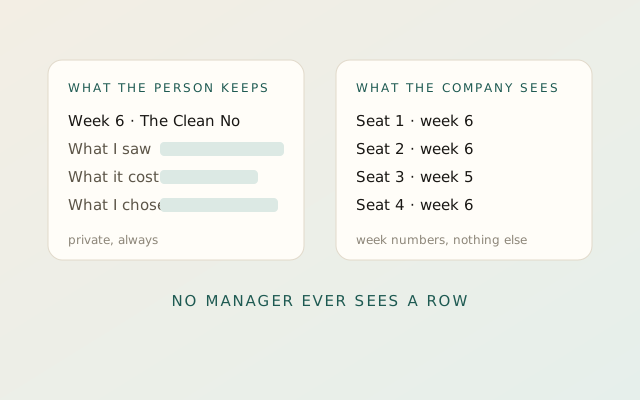
Every seat gets Part One. The company sees week numbers, nothing else.
Which week each seat is on. Whether it is active. The invoice.
Any log. Any answer. Any pattern name. Who said "not today".
Per seat, one payment, invoice. The founder takes the first ten calls.
I re-decide the same thing every bad Tuesday, and it has never once stayed decided.
I choose what I already have, and the reasons don't get to hold it for me.
- Relationships
- Health
- Wealth
- Happiness
- Career
How it works
Ten minutes a day. Nothing to track.
- 1
Day 1 · In your browser
One short story, three questions. Ten minutes, no account.
- 2
Days 2 to 6 · On WhatsApp
One message a day. Reply in a word, or "not today".
- 3
Day 7 · Your log seals
What you saw, what it cost, what you chose.
You might recognise this
Bram has stayed at the same firm for six years, and every quarter he decides to stay again.Read the story
Bram has stayed at the same firm for six years, and every quarter he decides to stay again. The spreadsheet lives in a folder called Options. Salary, pension, the twenty-minute commute; in the other, the things recruiters mention. After every salary review that disappoints him, he opens the file, updates a cell, and the staying column wins by a smaller margin than the year before.
Then a recruiter calls with a number that beats the staying column outright. Bram has the spreadsheet open while she talks, and it says go. And he notices, with the recruiter waiting, that he does not want to go, that he cannot say why, and that the not-wanting has no cell to live in. He tells her thank you, no. On Monday the desk is the same desk, and nobody is appealing. He works there now. Before, he had only been staying.
From Choosing, Not Deciding.
The turn
A founder's worst hours rarely go to new problems. They go to the retrying: the Sunday-night audit of a company you already own, the exit file updated after every setback, the same argument with the same co-founder in a slightly different costume.
Keep reading
Nothing about the business changes when that stops. Everything about the week does, because the energy that was going into the appeal comes back.
What a founder gets from Keel is ten minutes a day and a written record of which of their decisions are actually choices, kept somewhere no investor, board member or employee can read it.
Why it is called Keel
The part of the boat you never see.
A keel sits under the waterline. Nobody admires it from the dock. But when the wind hits, it is the reason a boat stays upright and holds its course instead of going wherever it is pushed.
What it costs
Free for the person. Per seat for the company.
- Ten minutes in your browser
- Six days on WhatsApp
- Your first log, sealed
- Eleven weeks for every seat
- No manager ever sees a log
- Price set with the first ten teams
Parts Two to Four are $199 each, and each one opens when you finish the part before.
What you can count on
Four promises, kept by how it is built.
Private by design
The company sees which week each seat is on. Never a log, an answer or a name.
Nothing renews
Part One is one payment. No subscription, no auto-renew, no countdown.
Honest about what it is not
Not therapy. If what comes up is more than a pattern, Keel points you to real help.
Built on published work
94 sources, from Heidegger to Frankl. The whole bibliography is public.
One question a day, and your own words back. No feed, no streak, no leaderboard. I answer every message and take the first ten team calls myself. If session one shows you nothing true in ten minutes, close the tab; it kept nothing.
Krish, founder
What do founders actually take to a coach?
Rarely a strategy question. Usually a loop: the same decision reopened, the same person avoided, the same week repeated with different names in it. Founders are surrounded by people with a stake in their answers, which is why the useful work is often just getting the thing said plainly once, in words nobody is going to quote back in a board meeting.
How is this different from having an executive coach?
An executive coach gives you an hour with a person who watches you and asks. This is smaller and more frequent: one idea a week, ten minutes a day, and a written line at the end of each week in your own words. It does not replace a good coach if you have one and use them. It does reach the Tuesdays between the sessions, which is where the loops actually run.
Why do the same decisions keep coming back?
Because they were settled on evidence, and anything settled on evidence can be retried the day the evidence changes. Every option you did not take stays filed as a standing objection, so the more carefully you weighed, the more objections you carry. The loop ends when the thing stops being held by its reasons, which is a different act from weighing them again more thoroughly.
If I buy seats for my team, what do I see?
Which week each seat is on, whether it is active, and the invoice. That is the whole of it. You never see a log, an answer, a name for anybody's pattern, or who said "not today", and neither does anyone else in the company. No manager ever sees a log. That is how it is built, and it is the reason people write the true thing rather than the presentable one.
How is it bought?
Per seat, one payment, no subscription, on an invoice rather than a card. Pricing is being set with the first ten teams instead of announced here, so there is no figure on this page. The founder takes those ten calls himself, twenty minutes, no deck. For yourself, there is nothing to buy first: run session one and decide afterwards.
Read next
Ten minutes, no account, and you'll have your own version of this named.
Run session one yourself first. Then talk to the founder about seats.