An employee development program people actually finish
Completion is not a motivation problem. It is a design problem.
Ten minutes, no account. Feel it before anyone signs anything.
- No manager ever sees a log
- 94 published sources
- Per seat, one payment, invoice
The short answer
An employee development program gets finished when finishing is cheap. Most are not: a two-day workshop, a course library, a launch email, and a completion rate that settles under a fifth by week three. The content is rarely the fault. The shape is. Anything that needs an hour, a calendar slot and a decision to attend is competing with the actual work, and the actual work wins.
What people finish is small, arrives on a schedule they did not have to remember, and asks one question instead of presenting a curriculum. Ten minutes, one idea a week, delivered where they already read messages. Then measure one thing rather than attendance: how many people can name something they do that costs them, and when they last did it. Tonight, ask three people what they took from the last program you ran. Their answers tell you what to buy next.
How it runs for a team
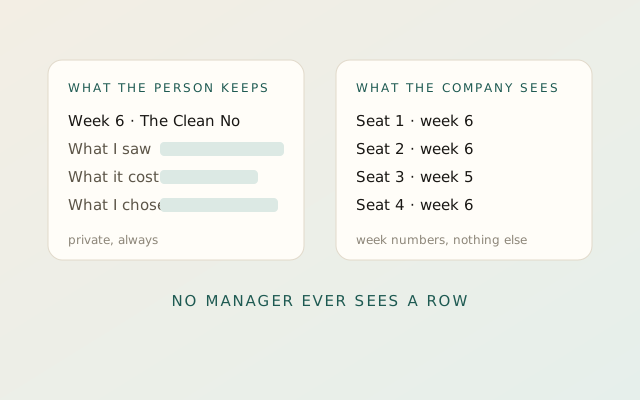
Every seat gets Part One. The company sees week numbers, nothing else.
Which week each seat is on. Whether it is active. The invoice.
Any log. Any answer. Any pattern name. Who said "not today".
Per seat, one payment, invoice. The founder takes the first ten calls.
I build a case before I ask, because a no would mean I shouldn't have asked.
I ask in one sentence and let no be an answer.
- Relationships
- Health
- Wealth
- Happiness
- Career
How it works
Ten minutes a day. Nothing to track.
- 1
Day 1 · In your browser
One short story, three questions. Ten minutes, no account.
- 2
Days 2 to 6 · On WhatsApp
One message a day. Reply in a word, or "not today".
- 3
Day 7 · Your log seals
What you saw, what it cost, what you chose.
You might recognise this
Devon runs sales for a small firm and is, by the numbers, mediocre, which baffles him, because he does everything right.Read the story
Devon runs sales for a small firm and is, by the numbers, mediocre, which baffles him, because he does everything right. His calls follow the training beat for beat: surface the pain point, handle objections, create urgency, always be closing. He can feel the exact moment it stops working, a slight cooling on the line, the answers getting shorter. So he works harder, and the harder he works, the colder they get.
His colleague Ruth tops the board every quarter. Shadowing her one Thursday, he watches her tell a hesitant client, "This is a real cost, and you know your business better than I do. What would make this an easy no?" The client laughs, visibly relaxes, starts thinking out loud, and twenty minutes later buys. Driving back, Devon finally sees the mechanism. His closing techniques are the resistance he keeps encountering.
From The Invitation Practice.
The turn
Most training hands people more moves. A shortage of moves is rarely the problem.
Keep reading
The problem is that the move already running is invisible to the person running it, so each new technique gets bolted onto it and inherits its grip. Devon did not need a better close. He needed to see, once, what his closing was doing to the room, in a way he could not unsee afterwards.
What a team gets from Keel is one of those sightings a week, written by the person who had it, in their own words: a sentence that is true on Monday and still true in March.
Why it is called Keel
The part of the boat you never see.
A keel sits under the waterline. Nobody admires it from the dock. But when the wind hits, it is the reason a boat stays upright and holds its course instead of going wherever it is pushed.
What it costs
Free for the person. Per seat for the company.
- Ten minutes in your browser
- Six days on WhatsApp
- Your first log, sealed
- Eleven weeks for every seat
- No manager ever sees a log
- Price set with the first ten teams
Parts Two to Four are $199 each, and each one opens when you finish the part before.
What you can count on
Four promises, kept by how it is built.
Private by design
The company sees which week each seat is on. Never a log, an answer or a name.
Nothing renews
Part One is one payment. No subscription, no auto-renew, no countdown.
Honest about what it is not
Not therapy. If what comes up is more than a pattern, Keel points you to real help.
Built on published work
94 sources, from Heidegger to Frankl. The whole bibliography is public.
One question a day, and your own words back. No feed, no streak, no leaderboard. I answer every message and take the first ten team calls myself. If session one shows you nothing true in ten minutes, close the tab; it kept nothing.
Krish, founder
Why do employee development programs have such low completion?
Because the unit is too big. A module that needs forty minutes and a quiet room competes with the day it is scheduled inside, and the day wins. Completion tracks the size of the ask far more than the quality of the material. Cut the unit to ten minutes, deliver it where people already read messages, and ask one question rather than presenting a chapter, and the number moves without anybody being chased.
What should we measure instead of completion?
Whether people can say something specific and unflattering about their own working habits, and name the last time it happened. That is the only evidence that a program has landed rather than been attended. It is also the reason completion dashboards feel hollow: they count attendance at a thing, not whether anyone can now catch themselves doing the thing the training was about.
Is this soft skills training or coaching?
Neither word is quite right. Soft skills training teaches moves. Coaching gives a person an hour with somebody who watches them. This is a third shape: one idea a week, ten minutes a day, and a question that only works if the answer is honest, which means the answer stays private to the person who wrote it. What it produces is recognition rather than technique.
What can the company see about its people?
Which week each seat is on, whether the seat is active, and the invoice. Nothing else exists on your side of it. No log, no answer, no name for anybody's pattern, and no record of who said "not today". No manager ever sees a log. That is how the product is built rather than a setting somebody can change, and it is the reason people write the true thing on day one.
How is it bought for a team?
Per seat, one payment, no subscription, invoiced rather than charged to a card. Pricing is being set with the first ten teams instead of published here, so there is no figure on this page. The founder takes those ten calls himself, and they run about twenty minutes. Before any of that, run session one yourself: the person signing should know what a seat actually feels like.
Read next
Ten minutes, no account, and you'll have your own version of this named.
Run session one yourself first. Then talk to the founder about seats.